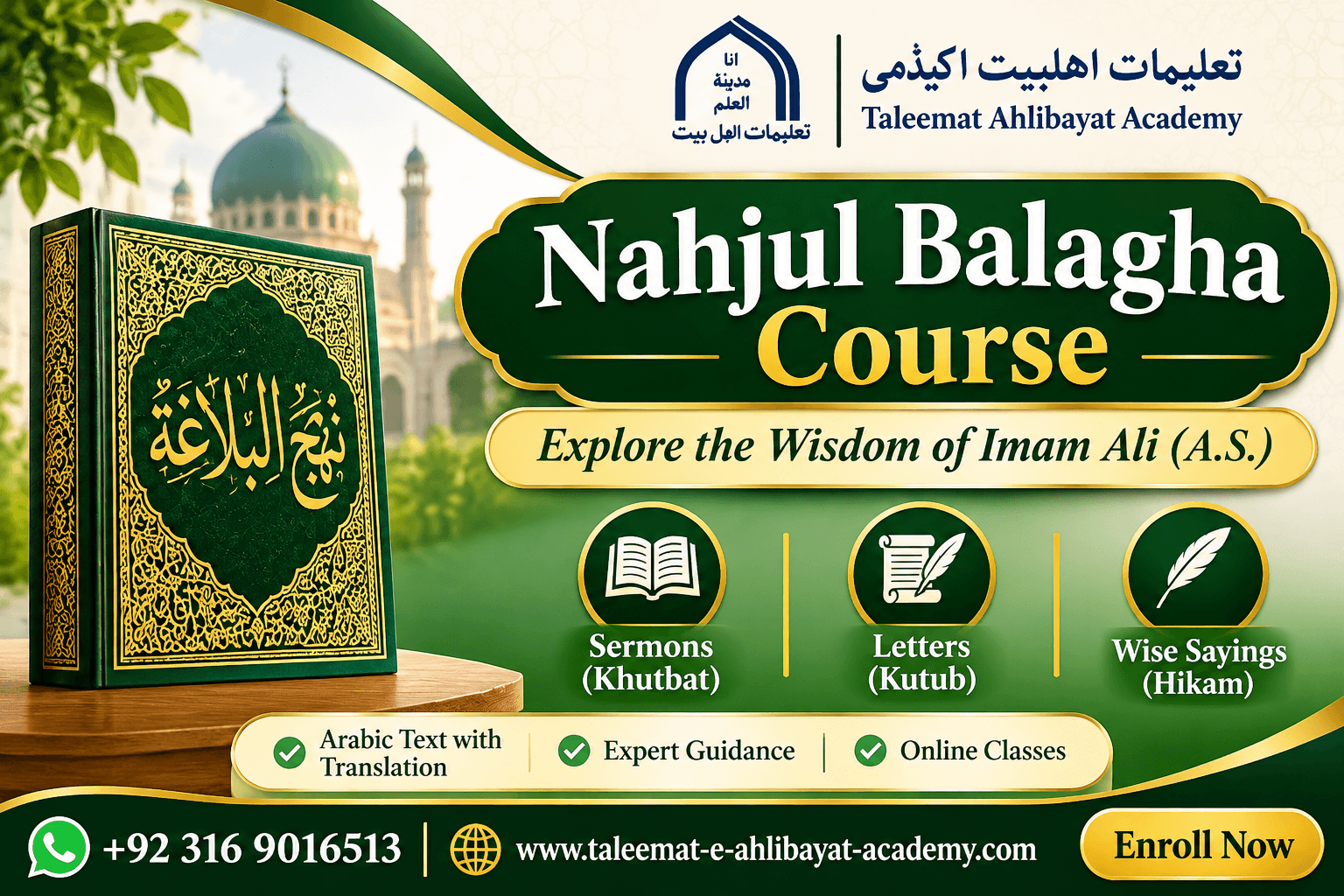
Nahjul Balagha Course
Explore the Wisdom, Eloquence & Teachings of Imam Ali (A.S.)
Study the Sermons, Letters, and Short Sayings of Imam Ali (A.S.) with Arabic Text, Translation, and In-Depth Explanation.
Nahjul Balagha is one of the most remarkable literary, intellectual, spiritual, and ethical treasures of Islamic heritage. Compiled by Sharif al-Radi (R.A.), this celebrated collection preserves a selection of sermons, letters, and short sayings attributed to Imam Ali ibn Abi Talib (A.S.), the first Imam of the Ahlul Bayt and the successor of the Holy Prophet Muhammad (PBUH) according to Shia belief.
The Nahjul Balagha Course at Taleemat Ahlibayat Academy is designed for students, researchers, religious seekers, and lovers of the teachings of Ahlul Bayt (A.S.) who wish to explore this extraordinary work in a systematic and meaningful way.
Through guided study, students will examine the original Arabic text, understand its vocabulary and literary expressions, explore its historical and theological context, and discover its profound teachings about Tawheed, spirituality, justice, leadership, ethics, society, and human responsibility.
Our objective is not merely to read Nahjul Balagha but to understand its message, appreciate its wisdom, and apply its teachings in everyday life.
What Is Nahjul Balagha?
Nahjul Balagha (The Peak of Eloquence) is a renowned collection of selected sermons, letters, and short sayings attributed to Imam Ali (A.S.).
It was compiled by Sharif al-Radi, a distinguished scholar and literary figure of the fourth Islamic century.
The collection is traditionally divided into three major sections:
1. Khutbat (Sermons)
The first section contains sermons addressing profound subjects such as the oneness of Allah, divine attributes, the creation of the universe, the Hereafter, the responsibilities of humanity, and the principles of Islamic governance.
2. Kutub (Letters)
The second section contains letters attributed to Imam Ali (A.S.), addressed to governors, representatives, companions, and other individuals. These letters offer valuable insights into justice, administration, leadership, social responsibility, and ethical governance.
3. Hikam (Wise Sayings)
The third section consists of short but deeply meaningful statements that express the wisdom of Imam Ali (A.S.) regarding knowledge, faith, patience, morality, self-discipline, human relationships, and spiritual development.
Together, these three sections offer a comprehensive opportunity to study the intellectual and spiritual dimensions of Imam Ali’s teachings.
Objectives of the Nahjul Balagha Course
The course aims to provide students with a structured understanding of Nahjul Balagha and its teachings.
By completing this program, students will be able to:
Understand the historical background and compilation of Nahjul Balagha.
Read and comprehend selected passages from the original Arabic text.
Improve Arabic vocabulary and comprehension through classical Islamic literature.
Understand the theological and philosophical discussions of Imam Ali (A.S.).
Explore the concepts of Tawheed, divine justice, and spirituality.
Study the principles of Islamic ethics and personal development.
Understand Imam Ali’s teachings on social justice and governance.
Examine the moral responsibilities of individuals and society.
Apply the wisdom of Nahjul Balagha to contemporary challenges.
Develop a deeper intellectual and spiritual connection with the teachings of Ahlul Bayt (A.S.).
Course Curriculum: What Will You Study?
Module 1: Introduction to Nahjul Balagha
Introduction to Imam Ali (A.S.) and his intellectual legacy.
Biography and scholarly contributions of Sharif al-Radi.
Historical background and compilation of Nahjul Balagha.
Structure and organization of the book.
Literary significance and eloquence of the text.
Introduction to the major themes and subjects.
Module 2: Study of Khutbat (Sermons)
Students will explore selected sermons of Nahjul Balagha, focusing on their meanings, historical contexts, and theological discussions.
Major topics include:
Tawheed and the Oneness of Allah.
Divine attributes and the limits of human understanding.
Creation of the universe and the natural world.
Prophethood and the mission of the Holy Prophets.
The status and responsibilities of the Holy Prophet Muhammad (PBUH).
The importance of the Holy Quran.
Death, Barzakh, Resurrection, and the Hereafter.
The dangers of worldly attachment.
Piety, sincerity, and spiritual purification.
Module 3: Study of Kutub (Letters)
This module examines selected letters attributed to Imam Ali (A.S.) and their relevance to Islamic ethics, leadership, and social life.
Important subjects include:
Principles of Islamic leadership.
Justice and equality in society.
Rights and responsibilities of rulers.
Public administration and accountability.
Rights of citizens and vulnerable communities.
Ethical responsibilities of government officials.
Social justice and public welfare.
Political wisdom and moral leadership.
Special Study: Letter 53 – The Letter to Malik al-Ashtar
One of the most important parts of this module will be a detailed study of Letter 53, traditionally addressed to Malik al-Ashtar.
Students will explore its principles concerning:
Justice and fairness.
Responsibilities of leadership.
Public service and administration.
Compassion toward the people.
Rights of different social groups.
Accountability and prevention of corruption.
Ethical conduct in governance.
Module 4: Study of Hikam (Wise Sayings)
This module focuses on the short sayings of Imam Ali (A.S.) and their practical significance.
Selected themes include:
Wisdom and knowledge.
Patience and perseverance.
Silence and thoughtful speech.
Humility and self-awareness.
Friendship and human relationships.
Contentment and gratitude.
Self-discipline and spiritual development.
The value of time and human life.
Truthfulness and sincerity.
The importance of good character.
Students will learn how these concise teachings can guide personal development and everyday decisions.
Module 5: Arabic Language and Literary Appreciation
This module introduces students to the linguistic and literary beauty of Nahjul Balagha.
Topics include:
Classical Arabic vocabulary.
Sentence structures and grammatical expressions.
Important grammatical and rhetorical features.
Balagha (Arabic rhetoric and eloquence).
Metaphors, similes, and literary expressions.
Understanding difficult passages.
Translation techniques and interpretation.
Module 6: Contemporary Applications of Nahjul Balagha
The final module focuses on applying the teachings of Imam Ali (A.S.) to modern individual and social challenges.
Topics include:
Nahjul Balagha and personal development.
Ethical leadership in the modern world.
Social justice and human dignity.
Family values and human relationships.
Knowledge, education, and intellectual responsibility.
Combating corruption and injustice.
Spirituality in contemporary life.
The relevance of Imam Ali’s teachings for today’s youth.
Teaching Methodology
The Nahjul Balagha Course follows a structured and interactive teaching methodology to ensure that students understand the text rather than simply memorize its translation.
Each lesson may include:
Original Arabic Text: Reading selected passages directly from Nahjul Balagha.
Word-by-Word Translation: Understanding important Arabic words and expressions.
Urdu and English Translation: Explaining the meaning of the text in accessible language.
Detailed Explanation: Discussing the theological, philosophical, ethical, and social dimensions of the selected passages.
Historical Context: Understanding the circumstances and background associated with selected sermons and letters.
Discussion and Reflection: Encouraging students to reflect on the teachings and discuss their practical applications.
Questions and Answers: Providing opportunities to clarify difficult concepts and deepen understanding.
Who Can Join This Course?
The Nahjul Balagha Course is suitable for:
Students of Islamic seminaries (Hawza Ilmiyyah).
University students of Arabic and Islamic Studies.
Islamic scholars and researchers.
Students interested in Shia theology and Islamic philosophy.
Individuals interested in the teachings of Imam Ali (A.S.).
Arabic language learners interested in classical Islamic literature.
Anyone wishing to understand Islamic ethics, spirituality, and wisdom.
Basic familiarity with Arabic is helpful for studying the original text, but students may also join translation-based classes according to their learning level.
Why Study Nahjul Balagha at Taleemat Ahlibayat Academy?
Taleemat Ahlibayat Academy is committed to providing quality Islamic education through structured online learning programs.
Our Nahjul Balagha Course aims to make the wisdom and teachings of Imam Ali (A.S.) accessible to students around the world.
What We Offer
Qualified and knowledgeable Islamic instructors.
Personalized one-on-one online classes.
Arabic text with Urdu and English translation.
Detailed explanations of selected sermons, letters, and sayings.
Flexible class schedules.
Interactive lessons through Zoom, Skype, and Google Meet.
Individual attention according to students’ learning needs.
Opportunities for questions, discussion, and reflection.
Classes for students worldwide.
Learn from the Wisdom of Imam Ali (A.S.)
Join Taleemat Ahlibayat Academy and begin your journey into the intellectual, spiritual, and ethical treasures of Nahjul Balagha.
Certification
Students who successfully complete the course and fulfill the required learning assessments will receive a Nahj-ul-Balagha Course Completion Certificate from Taleemat Ahlibayt Academy.
Frequently Asked Questions (FAQs)
1. What is Nahjul Balagha?
Nahjul Balagha is a famous collection compiled by Sharif al-Radi, containing selected sermons, letters, and wise sayings attributed to Imam Ali (A.S.).
2. Who compiled Nahjul Balagha?
Nahjul Balagha was compiled by Sharif al-Radi (R.A.), a renowned scholar and literary figure of the fourth Islamic century.
3. What are the three sections of Nahjul Balagha?
The three major sections are Khutbat (Sermons), Kutub (Letters), and Hikam (Wise Sayings).
4. Can beginners study Nahjul Balagha?
Yes. Beginners can study selected passages through translations and explanations. Students with Arabic knowledge can also explore the original text in greater detail.
5. Is knowledge of Arabic necessary for this course?
Arabic knowledge is helpful but not compulsory for translation-based lessons. Students can study the meanings and explanations in Urdu or English.
6. What will I learn from Nahjul Balagha?
You will explore Islamic theology, Tawheed, spirituality, ethics, justice, leadership, social responsibilities, and the wisdom of Imam Ali (A.S.).
7. Can I study Nahjul Balagha online?
Yes. Taleemat Ahlibayat Academy offers online learning opportunities through live classes, allowing students to study from anywhere in the world.
8. Who should study Nahjul Balagha?
It is beneficial for Hawza students, Islamic scholars, university students, researchers, and anyone interested in the teachings of Imam Ali (A.S.).
Enroll in the Nahjul Balagha Course Today!
Discover the profound wisdom of Imam Ali (A.S.) and explore one of the greatest intellectual and spiritual treasures of Islamic heritage.
Whether you are a student of Islamic studies, a researcher, or someone seeking spiritual and moral guidance, this course will help you develop a deeper understanding of Nahjul Balagha.
Start Your Learning Journey Today!
Taleemat Ahlibayat Academy
Website: https://www.taleemat-e-ahlibayat-academy.com/
WhatsApp / Call: +92 316 9016513
Learn the Wisdom of Imam Ali (A.S.). Understand His Teachings. Transform Your Life.