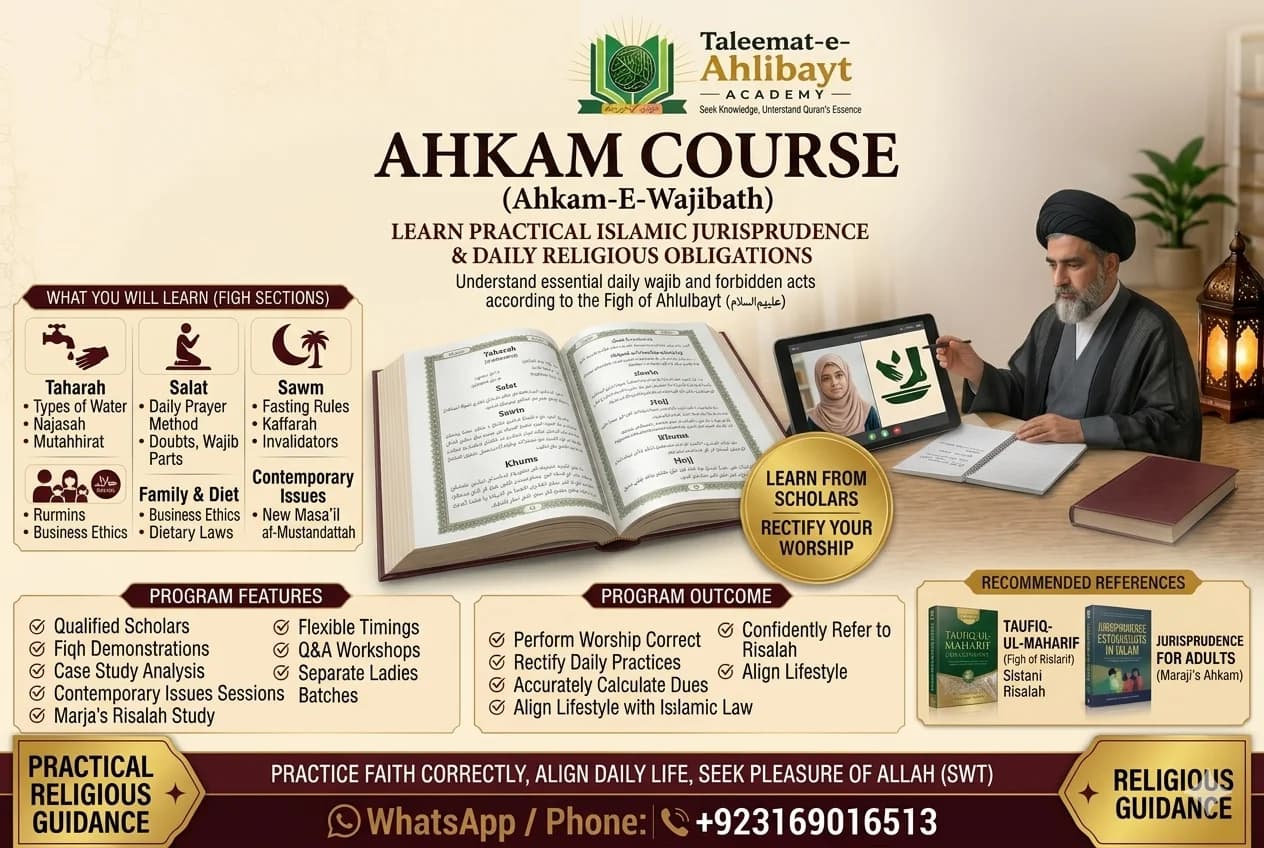
Ahkam Course (Ahkam-e-Wajibat)
Learn Practical Islamic Jurisprudence and Daily Religious Obligations
The Ahkam Course (Ahkam-e-Wajibat) is designed to provide students with essential knowledge of practical Islamic laws and daily religious obligations. The course covers the foundational rules of worship, purification, prayer, financial responsibilities and everyday interactions, enabling students to fulfil their religious duties correctly according to the Fiqh of Ahlulbayt (عليهم السلام) and the rulings of leading Maraji' (Grand Ayatollahs).
Students learn Islamic jurisprudence in a clear, accessible and practical manner under the guidance of qualified Islamic scholars.
Course Objectives
Students will:
Understand essential religious obligations (Wajibat) and prohibitions (Muharramat).
Learn the correct rules and practical methods of purification and prayer.
Develop an understanding of financial and social obligations in Islam.
Learn how to refer to and understand a Risalah (Islamic Laws Manual) of a Marja'.
Build confidence in applying Islamic rulings correctly in daily life.
What Students Will Learn
1. Purification and Prayer (Taharah and Salat)
Rules relating to water, Najasah (impurities) and Mutahhirat (purifying agents).
Practical methods and rulings of Wudu, Ghusl and Tayammum.
Daily obligatory prayers, including their conditions, essential components and correct method.
Rulings concerning doubts (Shakiyat) and mistakes during prayer.
Rules and practical guidance relating to Jama'at (congregational prayer) and Friday Prayer.
2. Fasting, Charity and Pilgrimage
Sawm, Khums, Zakat and Hajj
Rules of fasting, including conditions, invalidators (Mufattirat) and Kaffarah.
The principles and practical calculation of Khums and Zakat.
Basic rules and spiritual dimensions of Hajj and Ziyarah.
Introduction to the concepts of Jihad, Amr bil Ma'ruf (enjoining good) and Nahi anil Munkar (forbidding evil).
3. Social, Dietary and Financial Laws
Islamic rulings concerning Halal and Haram foods and drinks.
Rules governing Islamic business transactions, loans and ethical earnings.
Family jurisprudence, including the rights and responsibilities of parents, children and spouses.
Introduction to Taqleed, including understanding how to choose and follow a Marja'.
Course Features
Classes taught by qualified Islamic scholars and teachers trained in Islamic jurisprudence.
Rulings based on the teachings of Grand Ayatollah Sistani and other leading Maraji'.
Interactive online classes with live question-and-answer sessions.
Visual, practical and case-study-based learning.
Dedicated sessions addressing modern and contemporary issues (Masa'il al-Mustahdathah).
Flexible class timings.
Separate batches for men, women and young people.
Regular student progress assessments and reports.
Course Duration
3–6 months
Suitable For
This course is suitable for:
Teenagers who have reached the age of Bulugh (religious responsibility).
Adults seeking to review and improve their daily religious practices.
Those new to Ja'fari Fiqh.
Parents who want their children to learn the correct rulings for everyday religious practice.
Course Outcomes
After successfully completing the course, students will be able to:
Perform daily prayers and purification correctly according to Islamic law.
Understand the boundaries of Halal and Haram in food, finances and everyday life.
Understand and calculate religious dues such as Khums.
Refer to and navigate a Tauzih-ul-Masa'il (Book of Islamic Laws) independently.
Apply essential Islamic rulings confidently in their daily lives.
Teaching Methodology
The course uses a practical and interactive teaching approach, including:
Slide-based lessons.
Step-by-step visual demonstrations.
Real-life scenarios and case studies.
Interactive question-and-answer sessions.
Step-by-step practical videos covering Wudu, Ghusl and Salat.
Weekly short quiz sessions.
Direct references to recognised and authentic books of Fiqh.
Certification
Students who successfully complete the course requirements and course assessments will receive an Ahkam Course Completion Certificate from Taleemat-e-Ahlibayat Academy.