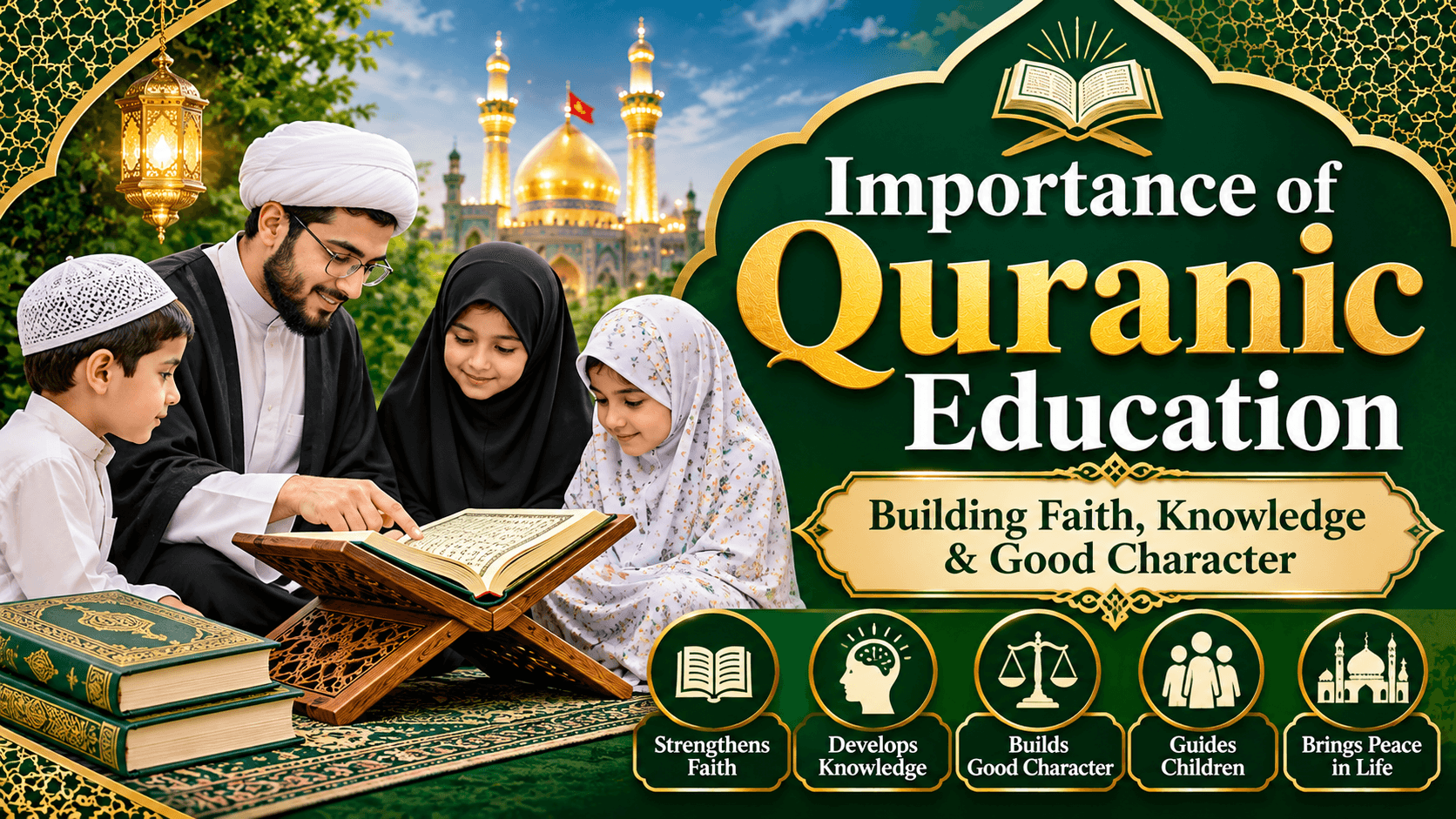
Importance of Quranic Education in Islam: Building Faith, Knowledge & Character
A Comprehensive Guide to the Importance of Teaching and Learning the Holy Quran According to the Quran and Ahlul Bayt (A.S.)
Quranic education is one of the most valuable foundations of Islamic life. The Holy Quran is not simply a sacred book to be recited; it is a divine source of knowledge, guidance, wisdom, and moral development. Teaching and learning the Quran enables individuals to understand their Creator, strengthen their faith, develop noble character, and fulfil their responsibilities toward society.
In the teachings of Prophet Muhammad (PBUH) and the Fourteen Masoomeen (A.S.), acquiring Quranic knowledge holds a special position. They encouraged Muslims to learn the Quran, teach it to others, reflect upon its message, and apply its guidance in everyday life.
In today's world, where children and young people face numerous intellectual, social, and moral challenges, Quranic education is more important than ever. It provides a strong foundation for faith, identity, discipline, and responsible living.
1. The Holy Quran: The Foundation of Islamic Education
Allah Almighty identifies the Quran as a book of guidance for humanity:
"This is the Book about which there is no doubt, a guidance for the God-conscious."
(Surah Al-Baqarah, 2:2)
This verse establishes the Quran as the foundation of divine guidance. Its purpose is not limited to teaching religious rituals; it also guides human beings toward knowledge, wisdom, justice, compassion, and righteousness.
Quranic education helps learners understand the purpose of creation, the relationship between humanity and Allah, and the responsibilities of a believer.
A person who studies the Quran with understanding gains more than information: they develop a framework for living according to divine principles.
2. Learning and Teaching the Quran Is a Noble Achievement
The Holy Prophet Muhammad (PBUH) encouraged Muslims to become learners and teachers of the Quran.
A famous narration states:
خَيْرُكُمْ مَنْ تَعَلَّمَ الْقُرْآنَ وَعَلَّمَهُ
Translation: "The best among you are those who learn the Quran and teach it."
This narration is recorded in Sahih al-Bukhari (Hadith 5027) and is also widely quoted in Islamic discussions of Quranic education.
It highlights two essential responsibilities: learning the divine message and passing that knowledge to others.
Quranic education is therefore not an individual achievement alone. It is also a means of serving the community, preserving divine knowledge, and guiding future generations.
3. Quranic Education According to Imam Ali (A.S.)
Imam Ali ibn Abi Talib (A.S.) placed great emphasis on acquiring Quranic knowledge, understanding its deeper meanings, and reflecting upon its teachings.
He states:
وَتَعَلَّمُوا الْقُرْآنَ فَإِنَّهُ أَحْسَنُ الْحَدِيثِ، وَتَفَقَّهُوا فِيهِ فَإِنَّهُ رَبِيعُ الْقُلُوبِ
Translation: "Learn the Quran, for it is the best of speech, and develop understanding of it, for it is the springtime of hearts."
Source: Nahjul Balagha, Sermon 110 in commonly used editions.
This teaching establishes that Quranic education must go beyond memorizing words. It should develop understanding, reflection, wisdom, and the ability to apply Quranic principles in everyday life.
4. Quranic Education Builds Strong Faith and Islamic Identity
One of the greatest responsibilities of Islamic education is to develop a strong relationship between individuals and their Creator.
Allah Almighty says:
يَرْفَعِ اللَّهُ الَّذِينَ آمَنُوا مِنكُمْ وَالَّذِينَ أُوتُوا الْعِلْمَ دَرَجَاتٍ
Translation: "Allah will raise those who believe among you and those who have been given knowledge by degrees."
(Surah Al-Mujadilah, 58:11)
Quranic education helps Muslims understand their religious beliefs, recognize their responsibilities, and develop a meaningful Islamic identity.
It teaches children and adults about Tawheed, Prophethood, divine justice, Imamate, and the Hereafter, while nurturing love for the Holy Prophet Muhammad (PBUH) and his purified household (A.S.).
5. Quranic Education Develops Moral Character
The purpose of Quranic education is not simply to produce skilled reciters or memorizers. It is also to develop individuals whose character reflects the values of the Holy Quran.
Allah (SWT) says:
إِنَّ اللَّهَ يَأْمُرُ بِالْعَدْلِ وَالْإِحْسَانِ
Translation: "Indeed, Allah commands justice and excellence."
(Surah Al-Nahl, 16:90)
Through Quranic education, students learn honesty, patience, humility, forgiveness, respect, kindness, and social responsibility.
A child who learns the Quran should gradually understand that respecting parents, speaking truthfully, helping others, and avoiding injustice are essential parts of Islamic life.
Thus, Quranic education contributes to the development of both religious knowledge and excellent human character.
6. The Importance of Quranic Education for Children
Childhood is one of the most important stages for developing beliefs, habits, and moral values. Introducing children to the Holy Quran at an early age creates a foundation for lifelong religious learning.
Allah Almighty says:
يَا أَيُّهَا الَّذِينَ آمَنُوا قُوا أَنفُسَكُمْ وَأَهْلِيكُمْ نَارًا
Translation: "O you who believe! Protect yourselves and your families from a Fire."
(Surah Al-Tahrim, 66:6)
Parents have an important responsibility to provide their children with religious education and help them develop a strong connection with Allah.
Early Quranic education helps children:
Learn correct Arabic pronunciation.
Develop the ability to recite with Tajweed.
Memorize Quranic Surahs and verses.
Understand basic Quranic meanings.
Develop love for Allah and Ahlul Bayt (A.S.).
Build confidence in their religious identity.
Practice Islamic manners and values.
The goal should be to make children love the Quran rather than consider it merely a compulsory subject.
7. Quranic Education Through the Teachings of Ahlul Bayt (A.S.)
The Fourteen Masoomeen (A.S.) represent the highest examples of Islamic guidance and the practical embodiment of Quranic teachings.
The Prophet Muhammad (PBUH) emphasized the inseparable relationship between the Quran and his Ahlul Bayt in the famous Hadith al-Thaqalayn.
He said:
إِنِّي تَارِكٌ فِيكُمُ الثَّقَلَيْنِ كِتَابَ اللَّهِ وَعِتْرَتِي أَهْلَ بَيْتِي
Translation: "Indeed, I leave among you two precious things: the Book of Allah and my family, my Ahlul Bayt."
This tradition is reported in various Sunni and Shia sources, including Sahih Muslim (Hadith 2408).
For followers of the Ahlul Bayt, Quranic education should therefore include studying the Quran alongside the authentic teachings and explanations of the Prophet's household.
Their teachings help students understand the ethical, spiritual, and practical dimensions of divine revelation.
8. The Importance of Tajweed in Quranic Education
Learning the Quran correctly requires attention to pronunciation, articulation, and the rules of recitation.
Tajweed teaches students how to pronounce Arabic letters from their correct points of articulation (Makharij), observe their characteristics (Sifaat), and apply the rules of proper Quranic recitation.
Allah Almighty says:
وَرَتِّلِ الْقُرْآنَ تَرْتِيلًا
Translation: "And recite the Quran in a measured and distinct manner."
(Surah Al-Muzzammil, 73:4)
Tajweed education helps learners:
Pronounce Arabic letters correctly.
Recognize the rules of Noon Sakinah and Tanween.
Understand the rules of Madd.
Apply the rules of Meem Sakinah.
Observe proper stopping and starting (Waqf and Ibtida).
Improve fluency and accuracy in recitation.
Proper Quranic education should combine theoretical knowledge with practical recitation under the supervision of a qualified teacher.
9. Quranic Education Protects Future Generations
In the modern world, children and young people encounter numerous influences through social media, entertainment, and digital communication.
Without a strong foundation of religious knowledge and moral values, they may struggle to distinguish between beneficial and harmful influences.
Quranic education provides a framework for understanding right and wrong, developing critical moral judgment, and maintaining a meaningful connection with Islamic principles.
It helps young people develop:
Religious awareness and responsibility.
Respect for human dignity.
Self-discipline and accountability.
Awareness of social justice.
Resistance to harmful behavior.
A balanced approach to worldly and spiritual life.
Quranic education should not isolate children from the modern world. Rather, it should equip them with the knowledge and character to participate in it responsibly.
10. The Responsibility of Parents, Teachers, and Islamic Institutions
Quranic education is a shared responsibility. Parents, teachers, scholars, and Islamic educational institutions all have an important role in nurturing a Quran-oriented generation.
Parents should encourage daily Quranic recitation at home and provide a positive religious environment.
Teachers should teach with patience, sincerity, knowledge, and compassion, recognizing the different learning abilities of students.
Islamic institutions should provide structured Quranic programs that combine recitation, Tajweed, memorization, translation, Tafsir, and Islamic values.
An effective Quranic educational system should focus not only on completing lessons but also on developing a lasting relationship with the Book of Allah.
11. The Role of Online Quranic Education in the Modern World
Technology has created new opportunities for Muslims around the world to access Quranic education.
Online Quran academies allow children, adults, and families to learn the Holy Quran regardless of their geographical location.
Through online learning, students can receive individual attention from qualified Quran teachers and progress according to their abilities.
The benefits of online Quranic education include:
One-on-One Learning: Personalized lessons according to individual learning needs.
Flexible Timings: Students can learn at convenient times.
Qualified Teachers: Access to experienced male and female Quran instructors.
Proper Tajweed: Individual correction of pronunciation and recitation mistakes.
Worldwide Accessibility: Quranic education for Muslims living in different countries.
Continuous Learning: Opportunities to study recitation, memorization, translation, and Tafsir.
Online Quran education can therefore play an important role in making authentic Quranic knowledge accessible to the next generation.
12. Every Muslim Should Become a Student of the Quran
Quranic education is not restricted to children or religious scholars. Every Muslim, regardless of age, profession, or educational background, should maintain a relationship with the Holy Quran.
Imam Ja'far al-Sadiq (A.S.) is reported to have said:
يَنْبَغِي لِلْمُؤْمِنِ أَنْ لَا يَمُوتَ حَتَّى يَتَعَلَّمَ الْقُرْآنَ أَوْ يَكُونَ فِي تَعْلِيمِهِ
Translation: "It is appropriate for a believer not to die until they have learned the Quran or are engaged in teaching it."
Source: Al-Kafi, Vol. 2, Kitab Fadl al-Quran, Chapter 3, Hadith 3. The chain of this particular report is classified as disconnected (Mursal) in Allama Majlisi's Mir'at al-Uqul, so it should not be presented as an independently authenticated narration.
This narration expresses an important educational ideal: a believer should remain connected to Quranic learning throughout life, whether as a student or a teacher.