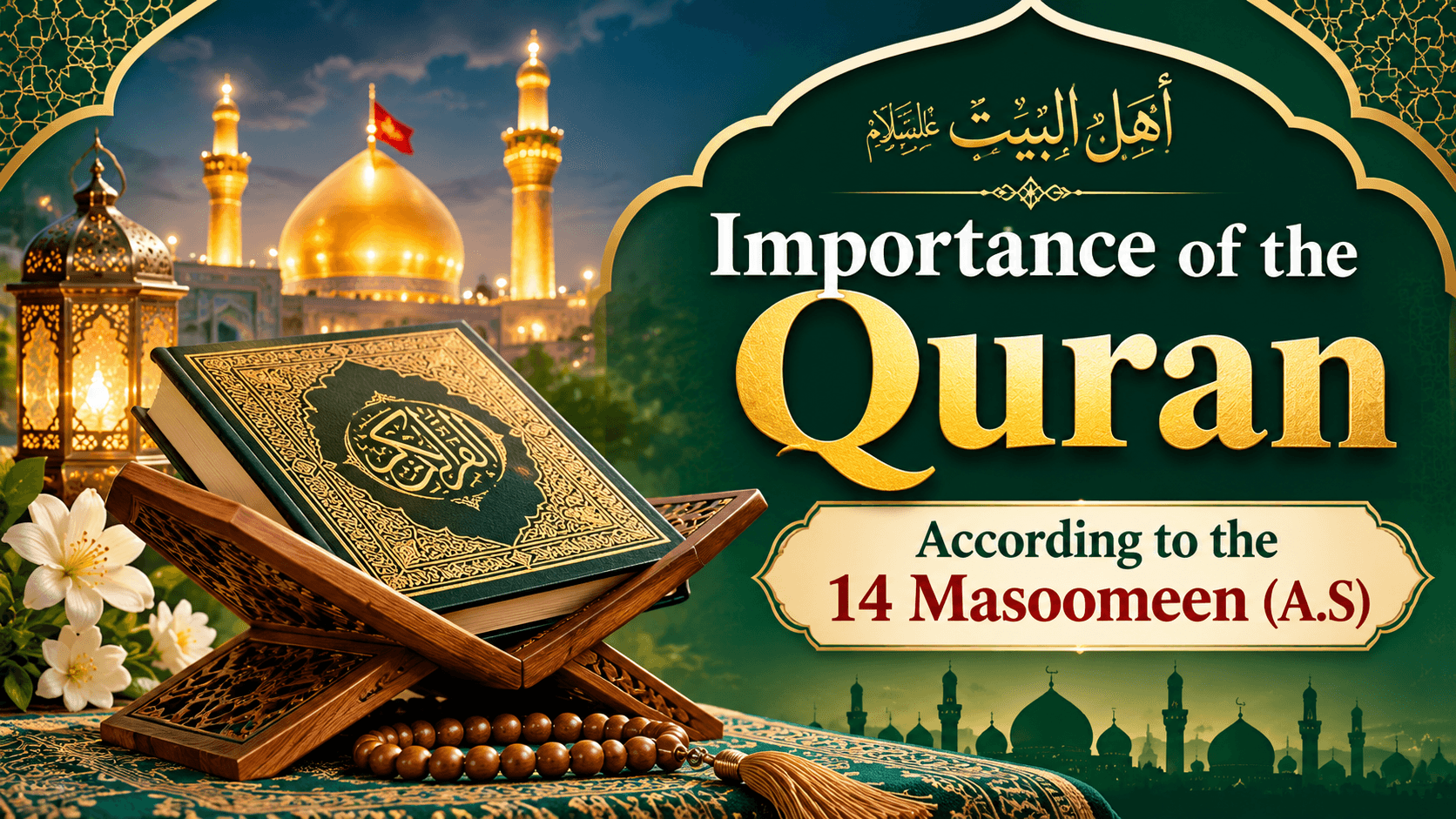
Importance of the Holy Quran According to the 14 Masoomeen (A.S.)
The Divine Book of Guidance, Spiritual Enlightenment, and Eternal Salvation in the Teachings of Ahlul Bayt (A.S.)
The Holy Quran is the final divine revelation bestowed upon humanity by Almighty Allah (SWT) through His beloved Prophet Muhammad (PBUH). It is not merely a sacred book to be recited, but a comprehensive source of guidance, wisdom, morality, spirituality, and divine knowledge. According to the teachings of the Fourteen Masoomeen (A.S.), the Quran occupies the highest position in the life of a believer, serving as a light for the heart, a guide for human conduct, and a means of attaining closeness to Allah.
The Ahlul Bayt (A.S.) consistently emphasized that the true significance of the Quran lies not only in its recitation but also in understanding its message, reflecting upon its verses, and implementing its teachings in everyday life.
1. The Holy Quran: A Divine Guide for Humanity
Allah Almighty declares in the Holy Quran:
“Indeed, this Quran guides to that which is most upright.”
(Surah Al-Isra, 17:9)
This verse establishes the Quran as the ultimate source of divine guidance. It directs humanity toward the path of righteousness, justice, truth, and spiritual perfection.
According to the teachings of the Prophet Muhammad (PBUH) and his Ahlul Bayt (A.S.), the Quran provides guidance for every dimension of human existence, including faith, worship, family life, social relationships, moral conduct, and individual responsibility.
The Holy Prophet (PBUH) encouraged Muslims to hold firmly to the Quran and regard it as their guide and leader.
The Prophet (PBUH) said:
“You must adhere to the Quran, so take it as an Imam and a leader.”
(Kanz al-Ummal, Hadith 4029)
This prophetic teaching demonstrates that the Quran is not simply a book of religious recitation; it is a divine authority that should guide the decisions, values, and direction of a believer’s life.
2. The Holy Quran as the Greatest Source of Knowledge
One of the most important teachings of the Ahlul Bayt (A.S.) is that the Holy Quran contains profound knowledge concerning Allah, humanity, the universe, and the ultimate purpose of creation.
Imam Ali ibn Abi Talib (A.S.) described the Quran as a comprehensive source of knowledge and wisdom.
In Nahjul Balagha, Imam Ali (A.S.) explains that the Quran contains knowledge of the past, information concerning the future, and guidance regarding the matters that human beings need.
He states:
“In it is the news of what was before you, the information of what comes after you, and the judgment of what is between you.”
(Nahjul Balagha, Sermon 176)
This statement highlights the comprehensive nature of the Quran. Its teachings are not restricted to a particular historical period or geographical region. Rather, its principles remain relevant to humanity across generations.
For Muslims, studying the Quran with the guidance of the Ahlul Bayt (A.S.) opens the door to deeper understanding of divine wisdom and the realities of human existence.
3. The Quran: A Healing for the Human Heart
The Holy Quran provides spiritual healing and guidance for those struggling with doubt, anxiety, moral weakness, and spiritual distance from Allah.
Allah Almighty says:
“And We send down of the Quran that which is healing and mercy for the believers.”
(Surah Al-Isra, 17:82)
Imam Ali (A.S.) emphasized the Quran’s ability to heal spiritual and moral diseases.
In Nahjul Balagha, he describes the Quran as a source of healing from the greatest illnesses of the heart, including disbelief, hypocrisy, error, and misguidance.
(Nahjul Balagha, Sermon 176)
The Quran strengthens faith, encourages patience, cultivates gratitude, and reminds believers of the eternal purpose of life.
Its verses provide comfort during hardship and inspire hope when a person feels overwhelmed by the difficulties of worldly existence.
Therefore, regular Quranic recitation accompanied by reflection can become a powerful means of spiritual growth and moral transformation.
4. The Holy Quran and the Teachings of Imam Hasan (A.S.)
Imam Hasan ibn Ali (A.S.), the second Imam of the Ahlul Bayt, continued the Quranic mission of the Holy Prophet (PBUH).
His life demonstrated the practical application of Quranic values, including generosity, patience, forgiveness, compassion, and devotion to Allah.
The Quran teaches:
“Repel evil with that which is best.”
(Surah Fussilat, 41:34)
This principle reflects the moral spirit of the Ahlul Bayt (A.S.), who taught that a true believer should respond to hostility with wisdom, goodness, and self-control whenever appropriate.
The life of Imam Hasan (A.S.) provides an example of how Quranic teachings should be transformed into personal character and social conduct.
5. The Quran as a Source of Spiritual Light
Imam Zayn al-Abidin (A.S.), the fourth Imam, emphasized the intimate relationship between the believer and the Holy Quran.
A narration attributed to Imam Zayn al-Abidin (A.S.) states:
“If everyone from the east to the west were to die, I would not feel lonely as long as the Quran was with me.”
(Al-Kafi, Vol. 2, p. 602, Hadith 13)
This profound statement reveals the spiritual companionship that the Quran provides.
For a believer, the Quran is a source of reassurance, strength, and connection with Allah. Its verses illuminate the heart and provide guidance during moments of loneliness, uncertainty, and hardship.
The teachings of Imam Zayn al-Abidin (A.S.) encourage believers to develop a personal and continuous relationship with the divine revelation.
6. The Quran and the Path of True Understanding
Imam Muhammad al-Baqir (A.S.), the fifth Imam, dedicated his life to explaining the deeper meanings of Islamic teachings and the Holy Quran.
His teachings emphasized that Quranic knowledge should lead to understanding, wisdom, and righteous action.
The Quran states:
“Do they not reflect upon the Quran, or are there locks upon their hearts?”
(Surah Muhammad, 47:24)
This verse emphasizes the importance of contemplation and reflection.
The Ahlul Bayt (A.S.) taught that believers should not remain satisfied with merely reading the words of the Quran without understanding their meaning.
A genuine relationship with the Quran requires reflection upon its message, recognition of its moral lessons, and the willingness to transform one’s life according to its guidance.
7. Imam Ja’far al-Sadiq (A.S.): The Quran Is Fresh in Every Age
Imam Ja’far al-Sadiq (A.S.), the sixth Imam, profoundly emphasized the enduring relevance of the Holy Quran.
A narration attributed to Imam al-Sadiq (A.S.) explains:
“Allah did not make the Quran for a particular time rather than another, or for particular people rather than others. Thus, it is fresh in every age and for every people until the Day of Resurrection.”
(Bihar al-Anwar, Vol. 92, p. 15, Hadith 8)
This teaching highlights the timeless nature of the Quran.
Although its revelation occurred in a particular historical context, its divine principles continue to guide humanity in every generation.
The Quran addresses the fundamental realities of human life, including justice, morality, family relationships, social responsibility, knowledge, and spiritual development.
For this reason, Muslims should continue studying the Quran and discovering its guidance for contemporary challenges while remaining faithful to its authentic interpretation.
8. The Quran: A Source of Immense Spiritual Reward
The Ahlul Bayt (A.S.) encouraged believers to recite the Holy Quran regularly and recognize the immense spiritual reward associated with its recitation.
Imam Muhammad al-Baqir (A.S.) narrated that Allah grants reward for Quranic recitation, with the reward varying according to the circumstances of recitation.
According to a narration in Al-Kafi:
“Whoever recites the Quran while standing in prayer, Allah records one hundred good deeds for every letter.”
The narration also mentions rewards for recitation while sitting in prayer and outside prayer.
(Al-Kafi, Vol. 2, Kitab Fadl al-Quran, Hadith 1)
This teaching demonstrates the extraordinary spiritual value of engaging with the Quran.
However, the ultimate purpose of Quranic recitation is not merely the accumulation of rewards. It is to strengthen one’s relationship with Allah, deepen understanding, and cultivate a life of obedience and righteousness.
9. The Quran and the Ahlul Bayt (A.S.): Two Inseparable Sources of Guidance
One of the most important teachings of the Holy Prophet Muhammad (PBUH) concerning the Quran is the tradition of Thaqalayn.
The Prophet (PBUH) said:
“Indeed, I leave among you two precious things: the Book of Allah and my Ahlul Bayt. As long as you hold firmly to both, you will never go astray.”
(Sahih Muslim, Hadith 2408; also narrated in numerous Shia sources)
This tradition establishes the profound relationship between the Holy Quran and the Ahlul Bayt (A.S.).
The Quran provides divine revelation, while the Ahlul Bayt (A.S.) preserve, explain, and demonstrate its authentic teachings through their words and lives.
According to the Shia understanding of Islam, the true path of guidance requires adherence to both the Holy Quran and the teachings of the Prophet’s purified household.
The Ahlul Bayt (A.S.) are therefore not separate from the Quranic message; their lives represent its practical embodiment.
10. The Quran Must Be Practiced, Not Merely Recited
Imam Ali (A.S.) repeatedly warned believers against neglecting the practical teachings of the Holy Quran.
He stated:
“Allah, Allah, concerning the Quran! Let no one surpass you in acting upon it.”
(Nahjul Balagha, Letter 47 in commonly used editions)
This statement emphasizes that the true measure of a believer’s relationship with the Quran is reflected in their actions.
A person may recite the Quran beautifully, memorize numerous chapters, and possess extensive religious knowledge. However, the real purpose of the Quran is fulfilled when its teachings become visible in that person’s character and conduct.
The Quran encourages honesty, justice, compassion, humility, patience, and responsibility.
A Quranic believer should therefore demonstrate these values in their dealings with family, neighbors, society, and humanity.
11. The Responsibility of Parents and Islamic Educational Institutions
The teachings of the Ahlul Bayt (A.S.) highlight the importance of educating children through the Quran and developing a strong foundation of faith from an early age.
Parents and Islamic educational institutions have a significant responsibility to introduce children to the Holy Quran through proper recitation, Tajweed, understanding, and moral education.
Teaching children the Quran is not limited to helping them pronounce its words correctly. It also involves nurturing love for Allah, the Holy Prophet (PBUH), and the Ahlul Bayt (A.S.).
An effective Quranic education should help students:
Learn to recite the Holy Quran with correct Tajweed.
Understand the meanings and teachings of Quranic verses.
Develop strong Islamic beliefs and moral character.
Apply Quranic values in everyday life.
Build a lifelong relationship with the Book of Allah.
By combining correct recitation with meaningful understanding, educators can help nurture a generation that reflects the Quranic teachings in both knowledge and character.
Make the Holy Quran the Guide of Your Life
The teachings of the Fourteen Masoomeen (A.S.) establish the Holy Quran as the foundation of faith, knowledge, spirituality, and righteous living.
From the Holy Prophet Muhammad (PBUH) to Imam al-Mahdi (A.J.F.), the Ahlul Bayt (A.S.) have emphasized the importance of remaining connected to the divine revelation.
The Quran is a guide for the confused, a light for the heart, a healing for spiritual illnesses, and a source of wisdom for every generation.
However, its true importance becomes evident when believers move beyond recitation toward understanding, reflection, and practical implementation.
Let us therefore make the Holy Quran an essential part of our daily lives. Let us recite it with sincerity, study it with understanding, teach it to our children, and follow its teachings through the guidance of the Ahlul Bayt (A.S.).
May Allah Almighty grant us the ability to understand the Holy Quran, act upon its teachings, and remain among those who are guided by the light of Muhammad and Aal-e-Muhammad (A.S.).
Ameen