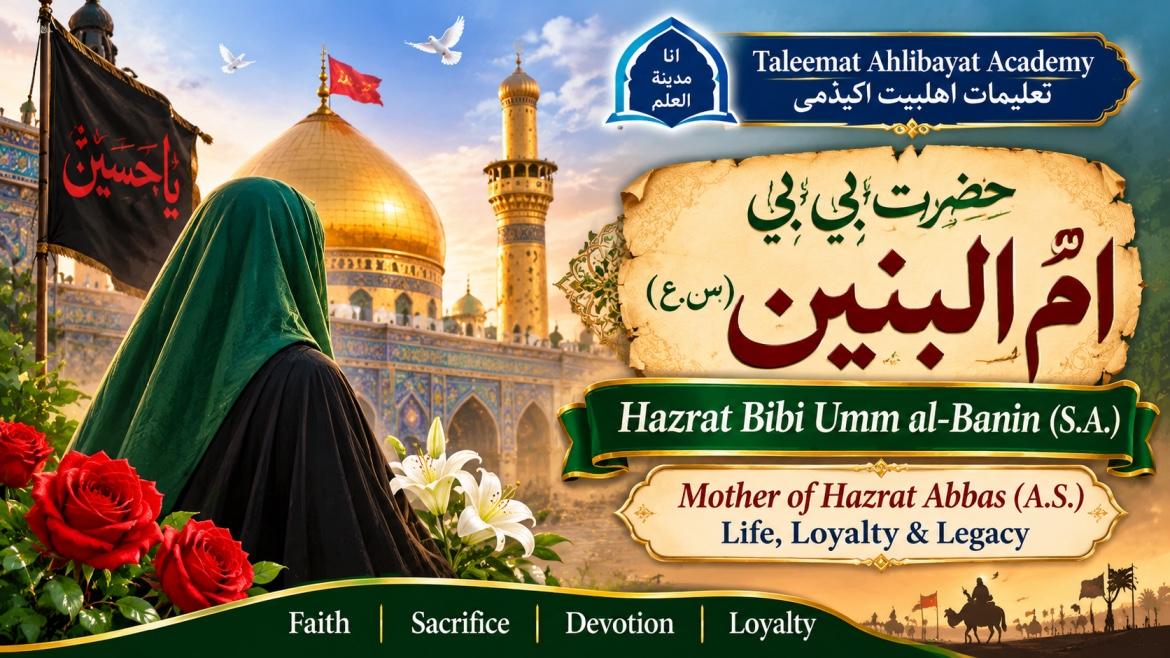
Hazrat Fatima Umm al-Banin (S.A.) was one of the most respected and noble women in Islamic history. She was the devoted wife of Imam Ali ibn Abi Talib (A.S.) and the beloved mother of Hazrat Abbas ibn Ali (A.S.) and his three brothers. Her life is remembered for her deep faith, loyalty to the Ahlul Bayt (A.S.), devotion to Imam Hussain (A.S.), and extraordinary patience following the tragedy of Karbala.
Her original name was Fatima bint Hizam al-Kilabiyya, while she became widely known by the title Umm al-Banin, meaning “Mother of Sons.” She holds a special place in the hearts of Muslims, particularly the followers of Ahlul Bayt (A.S.), because of her noble character, maternal love, and unwavering loyalty to the family of the Holy Prophet Muhammad (PBUH).
1. Noble Lineage and Family Background
Hazrat Umm al-Banin (S.A.) was born into the noble Arab tribe of Banu Kilab, a family known in Arab genealogical traditions for its courage and bravery.
Her father was Hizam ibn Khalid, and her mother is identified in historical accounts as Layla or Thamama bint Suhayl. She belonged to a respected family with a distinguished lineage.
Her upbringing in such a noble family contributed to the qualities of courage, generosity, eloquence, and dignity for which she became renowned.
2. Marriage to Imam Ali (A.S.)
After the martyrdom of Lady Fatima al-Zahra (S.A.), Imam Ali (A.S.) consulted his brother Aqil ibn Abi Talib, who was knowledgeable about Arab genealogy, regarding a suitable marriage.
According to the historical account mentioned by WikiShia, Aqil recommended Fatima bint Hizam because of her family’s noble lineage and reputation for bravery.
Imam Ali (A.S.) subsequently married her. She entered the household of Imam Ali (A.S.) with respect, humility, and devotion to the family of the Holy Prophet (PBUH).
It is also narrated that she preferred to be called Umm al-Banin rather than Fatima, so that the children of Lady Fatima al-Zahra (S.A.) would not be reminded of their mother’s name and the sorrow of her loss.
This account reflects the consideration and sensitivity traditionally associated with her character.
3. Mother of Hazrat Abbas (A.S.) and His Brothers
Hazrat Umm al-Banin (S.A.) had four sons:
Hazrat Abbas ibn Ali (A.S.) – The renowned standard-bearer of Imam Hussain (A.S.) in Karbala.
Abdullah ibn Ali (A.S.) – One of the martyrs of Karbala.
Ja’far ibn Ali (A.S.) – One of the devoted companions and martyrs of Imam Hussain (A.S.).
Uthman ibn Ali (A.S.) – Another son who attained martyrdom in the tragedy of Karbala.
All four sons participated in the events of Ashura and were martyred while supporting Imam Hussain (A.S.).
Because she was the mother of four sons, she became known as Umm al-Banin, meaning “Mother of Sons.”
Her motherhood is remembered not merely for raising courageous sons, but also for nurturing a family whose loyalty and sacrifice became an enduring part of the history of Karbala.
4. Her Love and Respect for Lady Fatima al-Zahra’s Children
One of the most remarkable aspects of Hazrat Umm al-Banin’s (S.A.) life was her relationship with the children of Lady Fatima al-Zahra (S.A.).
Historical accounts describe her as a woman who treated Imam Hasan (A.S.), Imam Hussain (A.S.), Lady Zaynab (S.A.), and the other members of the Prophet’s household with affection and respect.
She did not regard them merely as the children of her husband; rather, she recognized their spiritual position and their special relationship with the Holy Prophet (PBUH).
Her conduct is remembered as an example of compassion, humility, family harmony, and sincere devotion to the Ahlul Bayt (A.S.).
5. Hazrat Umm al-Banin (S.A.) and the Tragedy of Karbala
Although Hazrat Umm al-Banin (S.A.) was not present in Karbala, her four sons accompanied Imam Hussain (A.S.) and were martyred on the Day of Ashura, 10th Muharram 61 AH.
Her son, Hazrat Abbas (A.S.), became a symbol of loyalty, courage, and sacrifice. His brothers also stood beside Imam Hussain (A.S.) and gave their lives in support of the Imam.
The martyrdom of her four sons was an immense tragedy. However, her response to the news of Karbala became one of the most memorable accounts associated with her life.
6. Her Unparalleled Loyalty to Imam Hussain (A.S.)
When the survivors of Karbala returned to Madinah, Hazrat Umm al-Banin (S.A.) was informed about the martyrdom of her sons.
According to the account recorded by WikiShia, when she received the news, she first asked about Imam Hussain (A.S.) rather than her own children.
When she learned of his martyrdom, she expressed that she wished her sons and everything she possessed had been sacrificed for Imam Hussain (A.S.), had that meant he could have survived.
This response is traditionally remembered as a profound expression of her loyalty to Imam Hussain (A.S.) and her devotion to the Ahlul Bayt (A.S.).
Her love for the Imam was greater than her personal grief over the loss of her own children.
7. Her Relationship with Lady Zaynab (S.A.)
According to historical reports, when Lady Zaynab (S.A.) returned to Madinah after the tragedy of Karbala, she visited Hazrat Umm al-Banin (S.A.) and offered her condolences for the martyrdom of her sons.
This meeting reflects the deep emotional bond between the women of the household of Imam Ali (A.S.), who shared the pain and suffering of Karbala.
Their lives remain an enduring example of patience, faith, loyalty, and devotion.
8. Her Mourning for the Martyrs of Karbala
Following the tragedy of Karbala, Hazrat Umm al-Banin (S.A.) devoted herself to mourning Imam Hussain (A.S.) and the martyrs.
According to the historical account cited by WikiShia, she would visit Al-Baqi Cemetery in Madinah with her grandson Ubayd Allah, the son of Hazrat Abbas (A.S.), and recite elegies remembering her martyred sons.
People of Madinah would gather around her and share in her grief. Some historical reports even mention that Marwan ibn al-Hakam was moved to tears by her mourning.
She was also known for her poetic expression and eloquent elegies, particularly those remembering Hazrat Abbas (A.S.).
Through her mourning, she helped preserve the memory of the martyrs of Karbala and communicate the tragedy to the people of Madinah.
9. Her Virtues and Spiritual Status
Hazrat Umm al-Banin (S.A.) is remembered in Shia historical and biographical literature for several noble qualities:
Faith and Devotion: Her sincere commitment to the Ahlul Bayt (A.S.).
Loyalty: Her exceptional love and loyalty toward Imam Hussain (A.S.).
Patience: Her endurance following the martyrdom of her four sons.
Motherhood: Her role in raising Hazrat Abbas (A.S.) and his brothers.
Eloquence: Her ability to express grief and devotion through poetry.
Humility: Her respectful relationship with the children of Lady Fatima al-Zahra (S.A.).
Several scholars have praised her virtues and devotion. Al-Shahid al-Thani described her as a virtuous woman who possessed great affection and loyalty toward the family of the Holy Prophet (PBUH).
Her life continues to inspire generations, particularly women and mothers, to cultivate faith, patience, dignity, and devotion.
10. Demise and Burial Place
The exact date of the demise of Hazrat Umm al-Banin (S.A.) is not established with certainty in the historical records.
However, her demise is commemorated on the 13th of Jumada al-Thani, and WikiShia records 64 AH (684 CE) as the traditional date associated with her passing.
She was buried in Jannat al-Baqi Cemetery in Madinah, near other distinguished members of the family of the Holy Prophet (PBUH).
Her burial place remains an important site of remembrance for followers of Ahlul Bayt (A.S.).
11. Lessons from the Life of Hazrat Umm al-Banin (S.A.)
The life of Hazrat Umm al-Banin (S.A.) offers timeless lessons for humanity:
Loyalty to Truth: Her devotion to Imam Hussain (A.S.) demonstrates the importance of standing with truth and righteousness.
Respect for the Ahlul Bayt: Her love and respect for the children of Lady Fatima al-Zahra (S.A.) provide an example of sincere devotion.
Patience in Difficulties: Her response to the tragedy of Karbala reflects extraordinary patience and faith.
The Role of Mothers: Her sons’ courage and sacrifice highlight the importance of upbringing based on faith and noble values.
Preserving the Message of Karbala: Through her mourning and poetry, she contributed to keeping the memory of the martyrs alive.
Salam upon Hazrat Umm al-Banin (S.A.), the devoted mother of the heroes of Karbala.